A reading guide to this creator’s covered conversations.
The analyzed episodes span advanced information theory, foundational calculus, physics mechanics, and complex mathematical problem-solving through highly visual geometric explanations.
The analyzed episodes span advanced information theory, foundational calculus, physics mechanics, and complex mathematical problem-solving through highly visual geometric explanations. The creator consistently bridges abstract mathematical formulas and computational concepts—such as entropy, cross-entropy, and refractive indices—by mapping them onto intuitive spatial representations and interactive digital tools. Rather than relying solely on formal proofs or rote memorization, episodes deconstruct complex systems into simpler variants and geometric transformations. This approach emphasizes building deep human intuition, whether exploring multi-dimensional quaternion rotations, differential equation phase spaces, or modern AI reasoning limitations. Ultimately, the series reframes technical topics as interconnected puzzles where empirical simulation, visual pattern recognition, and rigorous definitions converge.
Geometric and Visual Intuition for Abstract Mathematics
Complex algebraic and trigonometric formulas are demystified by translating abstract concepts into physical shadows, unit circle projections, and geometric area problems.
Exploratory graphing tools and visual models allow students to observe non-trivial mathematical phenomena before formal algebraic proofs are introduced.
Information Theory, Compression, and Neural Network Foundations
Large language model pre-training and text compression are framed as equivalent facets of information theory, governed by Shannon noiseless coding limits and entropy formulas.
Cross-entropy loss functions and Kullback-Leibler divergence are derived from probabilistic mismatch costs, explaining why logarithmic functions standardise deep learning architectures.
Empirical and Computational Problem-Solving Methodologies
Solvers gain traction on complex tasks by constructing simpler variants, unpacking core definitions, and checking results against basic reasonability tests.
Writing programmatic scripts to simulate millions of random samples provides an invaluable empirical sanity check alongside traditional analytical derivations.
Physical Mechanisms Behind Dynamic Systems and Wave Phenomena
Light slowing down in transparent media is visualized through secondary wave emissions from oscillating internal charges creating cumulative phase shifts.
Differential equations and phase space vector fields map out how dynamical systems evolve, revealing the inherent limits of deterministic prediction in chaotic systems.
Mathematical constructs like quadratic formulas are directly connected to real-world engineering fields such as computer graphics ray tracing for animated films.
Abstract multi-dimensional number systems like quaternions and phase spaces are made comprehensible by translating them into spatial rotations and vector fields.
Recent 2026 episodes expand into advanced information theory and machine learning mechanics, framing large language models through data compression and cross-entropy loss functions.
Shared coverage: Mathematical Problem Solving Methodology · Mathematical Abstraction and Number Systems
THE CONVERSATIONS
Episode summaries
Browse covered conversations, newest original releases first.
The last IMO problem AI could not solveSep 18, 2026 · 52 min+
This video explores the intricacies of problem number six from the 2025 International Mathematical Olympiad, the sole contest question that initially resisted artificial intelligence solutions. By examining the geometric tiling of a 2025 by 2025 grid with specific gap constraints, the discussion unpacks the underlying construction, the rigorous lower-bound proof involving subsequence paths, and the Erdős-Szekeres theorem. The episode concludes with a broader philosophical reflection on why human mathematical understanding relies on motivated explanations rather than raw automated proofs.
Read episode summary But what is cross-entropy? | Compression is Intelligence Part 2Jul 16, 2026 · 34 min+
Cross-entropy acts as a bridge between information theory, file compression, and modern artificial intelligence training. The video explains how compression algorithms can cluster languages or identify authorship by measuring cross-document coding efficiency, effectively discovering linguistic structure without prior training. It then derives why cross-entropy is the mathematically optimal loss function for training large language models, explaining the necessity of logarithmic functions for minimizing information surprise. The discussion concludes by reframing LLM training as an exercise in compression and examining how model distillation leverages teacher distributions to improve efficiency.
Read episode summary Reinventing Entropy | Compression is Intelligence Part 1Jun 7, 2026 · 32 min+
Exploring the mathematical foundations of information theory, this video examines how Claude Shannon's work on data compression and entropy underpins modern artificial intelligence and large language models. Through intuitive examples involving robot movement instructions and binary trees, the discussion breaks down prefix-free codes, the negative log information formula, and historical experiments probing the compressibility of natural language.
Read episode summary But why would light "slow down"? | Visualizing Feynman's lecture on the refractive indexNov 30, 2023 · 29 min+
This video visualizes Richard Feynman’s explanation of why light appears to slow down inside a transparent medium like glass and how that phenomenon creates the index of refraction and prismatic dispersion. Rather than accepting light slowing as an unexamined axiom, the presentation breaks down the interaction into individual charged particles acting as driven harmonic oscillators. The secondary ripples emitted by these wiggling charges superimpose on the primary wave, producing cumulative phase shifts that match the macro-level observation of reduced propagation speed.
Read episode summary Tips to be a better problem solver [Last live lecture] | Ep. 10 Lockdown live mathMay 22, 2020 · 68 min+
In this final lockdown math lecture, Grant Sanderson outlines nine deceptively simple problem-solving principles through concrete mathematical explorations. Moving from the inscribed angle theorem in geometry to trigonometric proofs and an intricate probability puzzle involving random ratios, he demonstrates how rigorous pattern recognition, visualization, and computational simulation transform opaque algebraic challenges into intuitive insights. The session concludes by emphasizing that true mathematical ingenuity relies heavily on accumulated exposure to diverse patterns and methodical error-checking rather than innate genius.
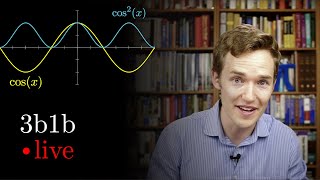
Grant Sanderson presents an intuitive, exploratory approach to trigonometry fundamentals, bridging the gap between high school right-triangle definitions and the dynamic geometry of unit circles. By leveraging interactive graphing software, viewers discover non-trivial properties such as half-angle identities and frequency doubling before encountering formal proofs. The lecture concludes with elegant geometric derivations of trigonometric relationships, setting the stage for future explorations connecting trigonometry with complex numbers.
Read episode summary The simpler quadratic formula | Ep. 1 Lockdown live mathApr 17, 2020 · 52 min+
While high school students widely memorize the traditional quadratic formula without expecting real-world application, advanced computational fields rely on it extensively. Grant Sanderson unpacks an alternative pedagogical approach for Lockdown Math, demonstrating how reframing quadratic equations through arithmetic patterns, the difference of squares, and mean-standard-deviation relationships makes root-solving intuitive. By connecting basic arithmetic tricks to polynomial coefficients and complex numbers, the lecture illustrates how alternative information representations enhance broader mathematical problem-solving skills.
Read episode summary Why do prime numbers make these spirals? | Dirichlet’s theorem and pi approximationsOct 8, 2019 · 22 min+
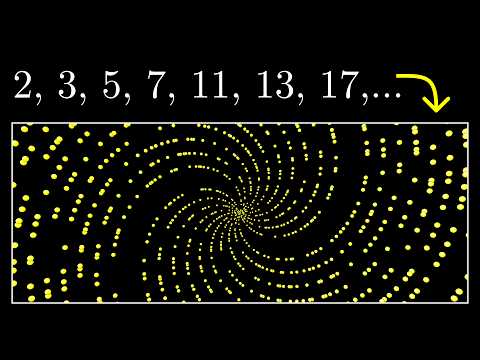
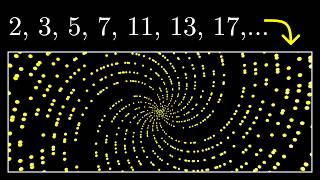
An exploration of a Math Stack Exchange visualization reveals how plotting integers and prime numbers in polar coordinates produces striking Archimedean spirals and ray patterns. The discussion breaks down how these visual structures emerge from close rational approximations of pi, such as 22/7 and 355/113, and how filtering for prime numbers connects to Euler's totient function and Dirichlet's famous theorem on prime distribution.
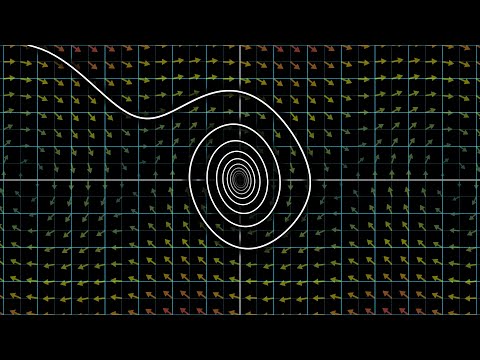
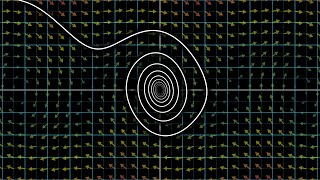
Differential equations describe how change occurs rather than absolute values, serving as the fundamental language of physics and dynamical systems. While exact analytical solutions are often impossible or intractable—such as with a non-linear pendulum—visualizing systems through phase spaces and vector fields allows mathematicians to build deep structural intuition without explicit formulas. The tour covers everything from Newtonian mechanics to numerical simulation and the inherent limits introduced by chaos theory.
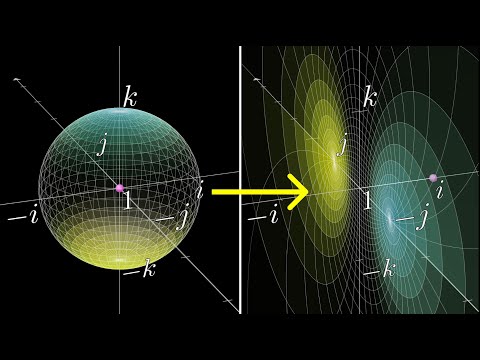
Irish mathematician William Rowan Hamilton discovered quaternions in 1843 as a four-dimensional extension of complex numbers, laying a mathematical foundation later adopted in computer graphics, robotics, and quantum mechanics. Visualizing these numbers requires stepping up dimensions through stereographic projection, moving from complex numbers on a line to 3D sphere rotations and finally to 4D hypersphere transformations. By modeling quaternion multiplication as synchronized, perpendicular two-dimensional rotations governed by right- and left-hand rules, complex algebraic properties become geometrically intuitive.