A reading guide to this creator’s covered conversations.
Epic History delivers immersive, multi-part narratives exploring major military campaigns, geopolitical upheavals, and institutional transformations across centuries of warfare.
Post Disaster Naval Institutional Reform · Emerging1 episodes · 10%
ABOUT THIS CREATOR
About
Epic History delivers immersive, multi-part narratives exploring major military campaigns, geopolitical upheavals, and institutional transformations across centuries of warfare. The programming combines granular operational breakdowns—such as naval tactics, logistical overhauls, and artillery deployments—with broad analyses of economic rivalries and state-directed policies. Episodes utilize detailed spatial and tactical framing to examine how leadership decisions, environmental challenges, and supply failures alter historical outcomes. Rather than relying on superficial summaries, the creator investigates the administrative and structural mechanisms driving pivotal conflicts from the Napoleonic Wars to twentieth-century geopolitical shifts. Across all analyses, the channel maintains a strong focus on the interplay between technological adaptation, financial strain, and command discretion.
Logistics, Financial Pressures, and State Resilience
Military effectiveness depends heavily on overhauling supply systems, securing financial tribute, and addressing frontline medical care to sustain troop morale.
Wartime budget shortfalls and economic devastation force governments into disastrous cutbacks, forced requisitions, or unfavorable treaty concessions.
Technological Innovation and Naval Supremacy in Warfare
Seapower relies on structural advancements like copper hull sheathing, carefully weighted gun decks, and strict crew organization to maintain global dominance.
Commercial rivalries over colonial trade routes and blockades frequently ignite major naval conflicts and technological adaptations.
Structural Determinism in Military and Economic Collapse
Financial exhaustion and inaccurate assumptions about adversary economies lead directly to strategic vulnerabilities, such as King Charles II mothballing the Royal Navy or Mao's distorted harvest figures triggering famine.
Rigid adherence to administrative plans over difficult terrain routinely causes operational paralysis and defeats for cumbersome armies.
Decisive Personal Leadership and Command Discretion
Commanders like Nelson and Napoleon break conventional rules by turning a blind eye to retreat signals or walking unprotected into royalist lines to convert hostile troops.
Hands-on valor during bridge assaults or rapid flanking maneuvers inspires fierce troop loyalty and shatters enemy morale at critical junctures.
Recent programming significantly broadens its historical scope beyond nineteenth-century Napoleonic campaigns to examine twentieth-century global conflicts, the Road to WWII, and modern Chinese history.
Later episodes place increased analytical weight on commercial rivalries, littoral naval disasters, and preemptive strikes in seventeenth- and nineteenth-century European conflicts.
By 2026, the channel expanded its chronological range significantly to encompass sweeping multi-part national histories, state-directed economic models, and twentieth-century global conflicts.
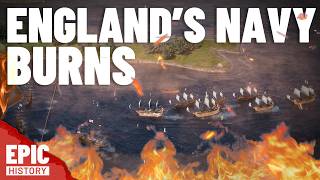
Driven by intense commercial competition over colonial trade routes, the Second Anglo-Dutch War exposed the fragile financial underpinnings of Restoration England. When King Charles II mothballed his fleet in late 1666 to cut costs, Dutch Grand Pensionary Johan de Witt seized the vulnerability to launch a daring surprise raid up the River Medway. The resulting destruction of England's premier warships and capture of the flagship Royal Charles forced a humiliating peace and catalyzed sweeping professional reforms within the Royal Navy.
Exiled to the tiny island of Elba after his defeat in 1814, Napoleon Bonaparte staged a daring escape and return to France in March 1815. Overcoming initial royalist resistance through personal charisma and military defections, he rapidly reclaimed the throne, prompting the major European powers to unite once more in the Seventh Coalition. Despite his trademark energy, Napoleon faced severe resource and leadership shortages as he prepared for a high-stakes preemptive strike against Allied armies in Belgium, culminating in the prelude to the Battle of Waterloo.
Tracing China's trajectory from the fall of the Qing Dynasty through foreign humiliations, civil wars, and revolutionary upheaval, this documentary explores how the nation transitioned from an isolated agrarian empire into a dominant global superpower. It examines the catastrophic policies of the Mao era, including the Great Leap Forward and Cultural Revolution, alongside Deng Xiaoping's pragmatic economic reforms that established special economic zones and lifted hundreds of millions out of poverty.
In March 1801, Vice Admiral Horatio Nelson led a daring British naval assault against Copenhagen to shatter the League of Armed Neutrality during the Napoleonic Wars. Despite navigating treacherous shoals, grounded flagships, and conflicting orders from his senior commander, Nelson combined tactical focus with aggressive diplomacy, ultimately breaking the coalition following the sudden assassination of Tsar Paul of Russia.
Between 1931 and 1934, the compounding shocks of the Great Depression destabilized fragile democracies, clearing a path for aggressive nationalist movements in Germany, Italy, and Japan. While international institutions like the League of Nations proved powerless against early territorial grabs such as Japan's invasion of Manchuria, totalitarian regimes accelerated internal industrialization and covert rearmament. This turbulent window set the stage for inevitable global collision, driven by revisionist powers seeking empires to resolve domestic crises.
Read episode summary The Abbasids: Islam's Golden Age (All Parts)Dec 1, 2023 · 47 min+
Rising from the ashes of the Umayyad dynasty in 747 AD, the Abbasid Caliphate presided over five centuries of extraordinary Islamic military expansion, administrative sophistication, and intellectual achievement. Anchored by the architectural marvel of Baghdad and institutions like the House of Wisdom, the empire catalyzed a golden age of science, translation, and trade before succumbing to internal military factionalism, regional fragmentation, and devastating Mongol conquest.
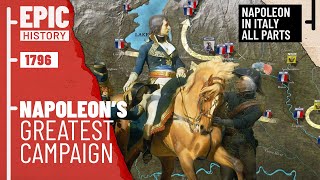
In 1796, a 26-year-old Napoleon Bonaparte assumed command of the demoralized French Army of Italy, transforming a ragged force into a legendary fighting machine. Over an intense eight-month campaign, Napoleon repeatedly outmanoeuvred superior Austrian and Piedmontese armies through lightning mobility, the exploitation of central positions, and aggressive operational pivoting. Despite severe logistical shortages, fierce rebellions, and early tactical setbacks at Caldiero and Arcole, Napoleon's tactical brilliance and personal leadership ultimately broke the coalition, secured northern Italy, and laid the foundation for his enduring military and political empire.
Fought in a blinding Polish blizzard in February 1807, the Battle of Eylau shattered Napoleon Bonaparte's streak of decisive, low-cost victories against coalition forces. Despite deploying massive artillery exchanges and committing legendary cavalry reserves led by Marshal Murat, the French Grande Armée suffered catastrophic losses against General Bennigsen's entrenched Russian army and late-arriving Prussian reinforcements. The engagement ended in a brutal, inconclusive stalemate that permanently altered the caliber of Napoleon's veteran force.
Read episode summary 3D Guide to an 18th century Ship-of-the-LineOct 21, 2023 · 53 min+
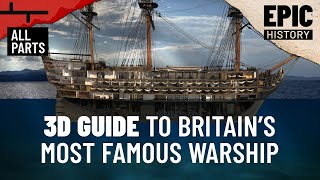
This documentary details the design, operation, and historical significance of HMS Victory, a legendary first-rate ship of the line that served as Vice Admiral Nelson's flagship at the Battle of Trafalgar in 1805. It examines the intricate mechanics of sail power, copper-sheathed timber preservation, gun deck architecture, and the demanding routines and discipline of an 820-man crew.
Read episode summary Napoleon in Italy: Battle of Rivoli (5/5)Aug 25, 2023 · 31 min+
In January 1797, 27-year-old General Napoleon Bonaparte faced a critical test at the Battle of Rivoli, where Austrian forces launched a multi-column offensive to relieve the starving garrison at Mantua. Despite being heavily outnumbered and facing severe logistical breakdowns, Napoleon leveraged rapid troop repositioning and aggressive cavalry counterattacks to rout the Austrian army. This decisive victory sealed Mantua's surrender, enabled a direct advance toward Vienna, and culminated in the Treaty of Campo Formio, cementing Napoleon's rising military legend.