A reading guide to this creator’s covered conversations.
OverSimplified delivers accessible, fast-paced historical narratives spanning classical Chinese dynastic cycles, European revolutions, and American conflicts.
Ulysses S Grant and Military Strategy · Emerging1 episodes · 10%
ABOUT THIS CREATOR
About
OverSimplified delivers accessible, fast-paced historical narratives spanning classical Chinese dynastic cycles, European revolutions, and American conflicts. The show systematically breaks down complex geopolitical turning points, structural economic vulnerabilities, and military strategies into digestible components. Episodes highlight how administrative corruption, shifting alliances, and unintended consequences continually derail ambitious rulers and fragile governments. Across subjects from the French Revolution to the American Civil War, the programming emphasizes the interplay between sweeping macro-historical trends and pivotal individual miscalculations. By examining historical turning points with meticulous attention to logistical realities, the series exposes the fragile foundations underlying seemingly monolithic empires.
Systemic Corruption and Dynastic Decay in Governance
Across ancient Chinese dynasties and European monarchies, administrative decay begins when minor heirs or entrenched elites prioritize self-serving luxury over public stability.
Severe financial strains, compounded by extractive taxation on the peasantry and extravagant court spending, consistently erode the legitimacy of ruling regimes.
Internal court factionalism and unchecked executive paranoia paralyze central administration, leaving governments acutely vulnerable to popular revolts and external shocks.
Military success repeatedly depends on innovative supply chain management and modular force design rather than sheer troop numbers alone.
Scorched-earth tactics and extended supply lines can catastrophically dismantle seemingly invincible invading armies, as demonstrated during Napoleon's Russian campaign.
Relentless battlefield attrition and strategic flanking maneuvers force defensive collapses when belligerents lack the industrial or demographic capacity to replace losses.
Unintended Consequences of Radical Legislative and Social Reforms
Aggressive government prohibitions and sweeping legal overhauls frequently spawn massive illicit black markets, widespread corruption, and violent organized crime syndicates.
Radical anti-clerical reforms and forced military conscription quotas provoke fierce counter-revolutionary peasant uprisings that destabilize fragile new republics.
Intentional constitutional compromises regarding systemic injustices like slavery preserve short-term national unity while cementing structural contradictions that guarantee future violent conflict.
Historical conflicts and political collapses are framed through structural and economic vulnerabilities rather than solely attributing outcomes to individual moral failings.
Financial ruin and inequitable tax burdens are systematically highlighted as primary catalysts for revolutionary uprisings, showing how systemic fiscal pressure forces societal upheaval.
Strategic decisions by military leaders are analyzed within the context of logistical constraints, industrial divergence, and demographic limitations rather than isolated tactical brilliance.
Long-term geopolitical shifts are depicted as inevitable consequences of institutional contradictions, such as the friction between expanding abolitionist movements and slave-reliant agricultural economies.
Episodes utilize chronological storytelling to trace the escalation of geopolitical crises, beginning with underlying systemic causes and culminating in decisive military or political turning points.
Narratives incorporate granular tactical details of major engagements, examining specific troop maneuvers, deceptions, and logistical bottlenecks that determined battlefield outcomes.
Coverage integrates socioeconomic and fiscal data—such as tax structures, alcohol excise contributions, and national debts—to explain the financial mechanisms driving major legislative shifts.
Historical profiles examine the unintended consequences of legal loopholes, executive overreach, and emergency decrees implemented during existential state crises.
After conquering continental Europe, Napoleon faced mounting resistance through British economic blockades, a brutal guerrilla insurgency in Spain, and a catastrophic invasion of Russia that decimated his Grand Armée. Although he briefly escaped exile from Elba to reclaim power during the Hundred Days, a decisive defeat at Waterloo sealed his downfall. This historical overview traces the unraveling of Napoleon's empire, highlighting the military strategies, logistical failures, and shifting political alliances that defined his final years.
Tracing Napoleon Bonaparte's meteoric ascent from an impoverished Corsican noble to Emperor of the French, this account examines the military innovations and political upheavals that reshaped Europe. Through brilliant strategic maneuver, speed, and the exploitation of enemy disunity, Napoleon dismantled successive European coalitions while centralizing domestic power through legal and economic reforms.
From the heavy-drinking culture of early America to the moral crusades of the temperance movement, this video explores the rise and fall of national alcohol prohibition. It examines how political strategists like Wayne Wheeler leveraged fear, wartime sentiment, and new income tax laws to enact the 18th Amendment, while detailing the staggering enforcement failures, rampant corruption, and booming organized crime syndicates that ultimately forced its repeal during the Great Depression.
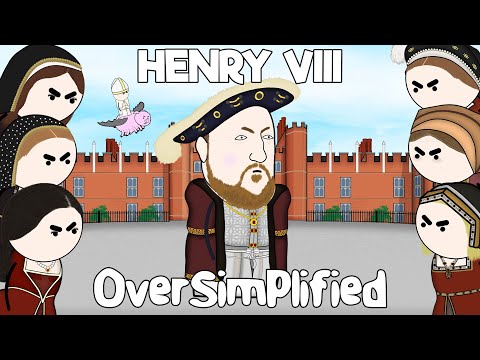
King Henry VIII transformed from a popular, cultured Renaissance prince into a tyrannical monarch whose desperate pursuit of a male heir and an annulment upended English religion and politics. Driven by dynastic anxiety and conflicts with the Pope and European powers, Henry's break with Rome reshaped national governance while leaving a legacy defined by marital turmoil and absolute authority. The narrative explores his early life, military ambitions, and the cascading political and personal consequences of his six marriages.
Read episode summary The American Civil War - OverSimplified (Part 2)Jan 31, 2020 · 23 min+
Following years of grinding stalemate, the American Civil War reached its turning point through decisive campaigns in the East and West, including Gettysburg, Vicksburg, and Grant's relentless attrition strategy. As war weariness threatened Abraham Lincoln's 1864 reelection, Union military advances ultimately secured victory, leading to the abolition of slavery via the Thirteenth Amendment and the beginning of a difficult reconstruction era.
Read episode summary The American Civil War - OverSimplified (Part 1)Jan 31, 2020 · 30 min+
The American Civil War erupted from decades of unresolved political compromises over slavery, westward expansion, and state versus federal authority. As the North industrialized and the South grew economically dependent on plantation slavery, fragile legislative balances like the Missouri Compromise repeatedly failed to contain escalating tensions. Abraham Lincoln’s election in 1860 triggered the secession of eleven Southern states, transforming a bitter legislative standoff into a devastating military conflict that forced a historic reckoning over the nation's foundational contradiction.
The War of the Bucket was a 14th-century conflict between the Italian city-states of Modena and Bologna, occurring amidst the broader, centuries-long struggle between the Pope and the Holy Roman Emperor. While popular legend suggests the war began over a stolen bucket, the conflict was primarily an extension of the ideological and political divide between pro-Papal Guelphs and pro-Imperial Ghibellines. The bucket was taken as a trophy only after Modena secured a decisive military victory at the Battle of Zappolino in 1325.
Read episode summary The French Revolution - OverSimplified (Part 2)Jun 28, 2019 · 22 min+
Following King Louis XVI's failed escape attempt and subsequent execution, the French Revolution descended from constitutional monarchy into the violent radicalism of the Reign of Terror under Maximilien Robespierre. As foreign wars and regional uprisings strained the fragile new republic, state-sponsored fear became official policy, resulting in tens of thousands of guillotine executions. This era of political paranoia and social upheaval ultimately paved the way for military hero Napoleon Bonaparte to seize absolute power through a coup in 1799.
Read episode summary The French Revolution - OverSimplified (Part 1)Jun 28, 2019 · 18 min+
Plagued by severe war debt and centuries of structural inequality, pre-revolutionary France pushed its starving working class to the breaking point through regressive taxation and elite excess. When King Louis XVI's attempt to resolve the financial crisis via the Estates-General failed due to rigged voting mechanics, the disenfranchised Third Estate revolted. This video chronicles the descent into chaos, detailing the formation of the National Assembly, the storming of the Bastille, and the violent populist movements that permanently dismantled absolute monarchy.
The collapse of China's four-century-long Han Dynasty triggered one of history's most chaotic civil wars, immortalized in the Three Kingdoms era. Driven by chronic court corruption, eunuch power struggles, and devastating peasant uprisings like the Yellow Turban Rebellion, the imperial government surrendered its monopoly on force to independent regional warlords. Figures like Cao Cao, Liu Bei, and Sun Quan vied for supremacy through shifting alliances, culminating in the decisive naval stalemate at the Battle of Red Cliffs. This fragmented power struggle ultimately concluded with reunification under the Jin Dynasty.