About
The "What If" channel delivers rigorous speculative science and astrophysics explorations by examining extreme hypothetical scenarios, cosmic phenomena, and planetary mechanics. Across episodes investigating human disappearance, instantaneous glacier melting, and scale-model solar system walks, the series translates complex physical laws into tangible, metric-driven thought experiments. Rather than relying on generic science trivia, the episodes ground cosmic phenomena in precise measurements, historical observations, and contemporary space agency data. By pairing macro-scale universal mechanics with granular earthly consequences, the show builds an accessible yet scientifically grounded framework for understanding Earth's vulnerability and place in the universe.
3 sources · 3 references
What If · 5:56 What If · 1:27 What If · 19:10Recurring themes
Examining planetary tipping points and severe environmental mechanics through extreme scenarios.
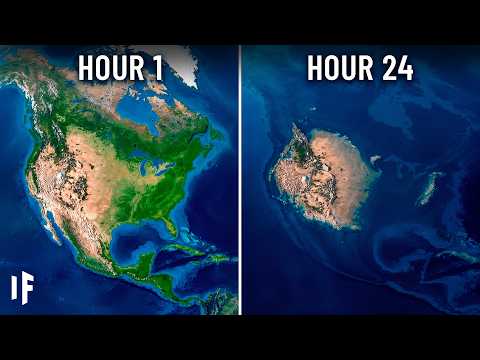
- Melting all mountain glaciers and ice caps would raise global sea levels by about 32 centimeters, while a full collapse of Greenland and Antarctic ice sheets would elevate levels by 65 meters and trigger dual tsunamis traveling at 800 kilometers per hour.
- Earth's 20 million square kilometers of reflective sea ice act as a temperature regulator; removing it accelerates severe climate feedback loops by increasing solar energy absorption.
1 source · 3 references
What If · 5:56 What If · 9:33 What If · 17:04Demystifying astronomical proportions through physical scaling models and cosmic distance corrections.
- Compressing the solar system into a 10-kilometer span across downtown Toronto illustrates how inner terrestrial planets sit tightly clustered within the first few blocks while outer planets extend across vast emptiness.
- The asteroid belt between Mars and Jupiter contains millions of rocks over a kilometer wide but possesses a total mass equal to only 3 to 4 percent of the Moon, making collisions rare despite cinematic depictions.
1 source · 3 references
What If · 1:27 What If · 7:56 What If · 18:52Debunking popular scientific myths with modern space probe discoveries and refined physical principles.
- Moon phases are caused by changing viewing angles during its 28-day orbit rather than Earth casting shadows, and comets travel tail-first on outbound journeys due to solar wind pressure.
- Spacecraft data reveals that Saturn's rings are only 10 to 100 million years old and possess half their previously estimated mass, while asteroids like Bennu are loose rubble piles rather than solid rocks.
1 source · 4 references
What If · 1:07 What If · 1:58 What If · 11:52 What If · 13:12Tracking the gradual decay of human civilization and the rapid rebound of nature following human absence.
- Without human operators, power plants shut down within a week, hospital generators exhaust fuel in 48 hours, and unmaintained roofs fail within two decades, allowing water infiltration to rot wooden framing.
- Restricted natural zones demonstrate how rapidly endangered species and fragile biodiversity rebound when direct human interference and hunting cease.
1 source · 3 references
What If · 1:14 What If · 13:00 What If · 15:07Unveiling the structural continuum of black holes from stellar-mass discoveries to ultramassive galactic anchors.
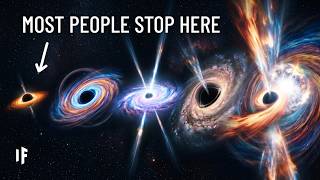
- Dormant stellar-mass black holes like Gaia BH1 are detected through the gravitational influence they exert on visible companion stars, compressing nine and a half solar masses into a 56-kilometer-wide event horizon.
- Ultramassive systems like Ton 618 at 66 billion solar masses approach the upper theoretical limits of growth, contrasting with microscopic primordial variants that would rapidly evaporate via Hawking radiation.
1 source · 4 references
What If · 0:40 What If · 12:50 What If · 15:02 What If · 19:54
Distinctive perspectives
Leveraging extreme hypothetical disruptions to evaluate the fragile interdependencies of Earth's biological and physical systems.
- By modeling instantaneous events like glacier melting or complete human absence, the show demonstrates how minor systemic shifts trigger massive feedback loops, such as alpine glacier loss drying up the Indus river and impacting two billion people.
- The series contrasts fragile modern infrastructure—such as power grids failing within days—with durable geological traces like stone monuments that persist for millennia, framing human civilization as a temporary disruption in deep geological time.
2 sources · 3 references
What If · 2:03 What If · 1:14 What If · 15:47Dismantling common cinematic tropes and outdated textbook facts through direct reference to space probe telemetry and modern astrophysical data.
- Episodes systematically replace popular myths—such as dense asteroid fields or the Big Bang as a localized explosion—with measured realities, citing NASA missions like OSIRIS-REx showing Bennu as a loose rubble pile rather than solid rock.
- The channel utilizes data from missions like Cassini and Gaia to update foundational scientific metrics, proving Saturn's rings are far younger than previously estimated and revealing dormant black holes via gravitational tracking.
2 sources · 4 references
What If · 8:27 What If · 11:52 What If · 0:40 What If · 13:12Coverage style
Step-by-step chronological breakdowns of extreme hypothetical events, tracking impacts hour by hour or century by century.
2 supporting episodes2 sources · 2 references
What If · 5:56 What If · 1:14Spatial scale modeling that translates astronomical distances into familiar urban geography and household objects.
1 supporting episodes1 source · 2 references
What If · 1:27 What If · 18:52Fact-checking formats that contrast widely held misconceptions with up-to-date data from space probes and telescopes.
1 supporting episodes1 source · 2 references
What If · 1:07 What If · 11:52Deep-dive categorizations of complex cosmic structures, mapping everything from stellar-mass black holes to ultramassive galactic anchors.
1 supporting episodes